
Introduction:
The way applications are built and deployed has changed fundamentally over the past decade. From monolithic servers to virtual machines, then containers, and now serverless, each evolution has removed another layer of infrastructure management from the developer's plate.
Serverless architecture represents the latest and most radical step in this progression. According to Research Nester, the global serverless architecture market was valued at approximately USD 12.43 billion in 2022 and is projected to reach USD 193.42 billion by 2035, growing at a CAGR of 25.70 percent. According to Datadog's State of Serverless report, AWS Lambda usage alone has grown by more than 100 percent year-over-year.
But serverless is not a silver bullet. It excels in certain scenarios and falls short in others. This guide provides a balanced, practical look at serverless architecture to help you decide whether it belongs in your technology stack.
What Is Serverless Architecture?
Despite the name, serverless architecture does not eliminate servers. Instead, it shifts the responsibility of provisioning, managing, and scaling servers entirely to the cloud provider. Developers write and deploy code without worrying about the underlying infrastructure.
Serverless computing falls into two main categories. Backend-as-a-Service (BaaS) provides managed third-party services such as databases, authentication, and storage. Function-as-a-Service (FaaS) allows developers to deploy individual functions that execute in response to specific events.
The most widely adopted FaaS platforms include AWS Lambda, Google Cloud Functions, and Microsoft Azure Functions. These platforms run code in stateless compute containers that are event-triggered, ephemeral, and fully managed by the provider.
At Codesis Technologies, we help businesses evaluate whether serverless architecture aligns with their workload characteristics, scaling requirements, and cost objectives before recommending an approach
How Serverless Architecture Works
The operational model of serverless architecture is fundamentally different from traditional deployment. In a conventional setup, you provision servers, configure scaling rules, and pay for compute capacity regardless of whether it is being used. With serverless, the cloud provider handles all of this automatically.
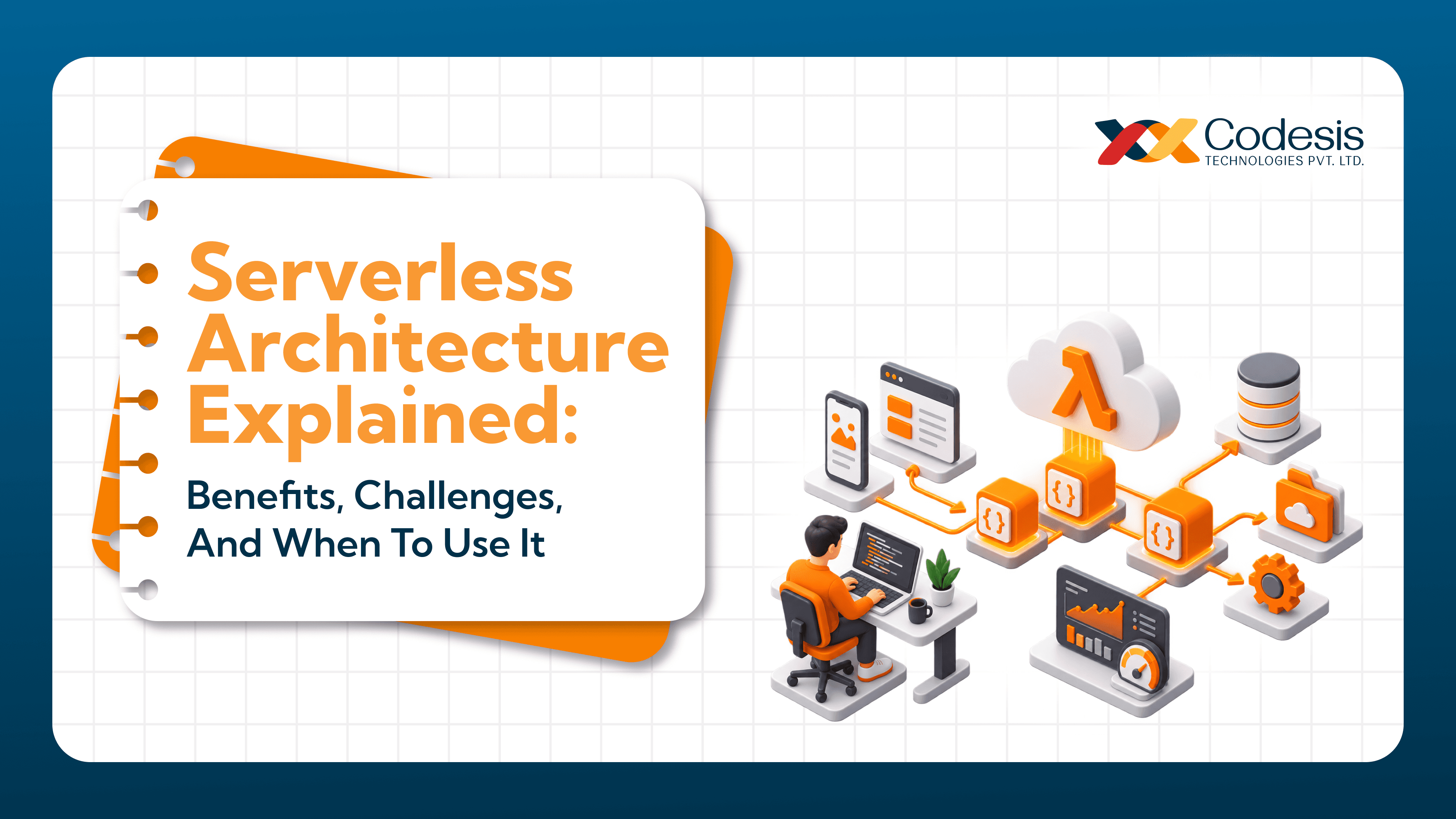
Here is the typical flow: a user action or system event triggers a function. The cloud provider instantly spins up a container to execute that function. Once the function completes, the container is terminated. You are billed only for the milliseconds your code actually ran.
This event-driven model is inherently efficient. There is no idle capacity being paid for, no infrastructure to patch, and no servers to monitor. However, this model also introduces considerations around cold starts, execution time limits, and state management that developers must account for.
Key Benefits of Serverless Architecture
Cost efficiency is the most frequently cited advantage. With serverless, you pay per execution rather than per hour or per server. For applications with variable or unpredictable traffic patterns, this model can reduce infrastructure costs by 60 to 80 percent compared to provisioned servers.
Automatic scaling eliminates the need for capacity planning. Serverless platforms scale horizontally in response to demand. Whether your function receives ten requests or ten million, the platform adjusts capacity instantly without manual intervention.
Faster time to market is another significant benefit. Because developers do not need to manage infrastructure, they can focus entirely on writing business logic. This concentration on code rather than configuration accelerates development cycles, particularly for startups and teams building MVPs.
Reduced operational overhead means smaller teams can deliver and maintain production systems. There are no servers to patch, no operating systems to update, and no network configurations to manage. The cloud provider handles availability, fault tolerance, and security at the infrastructure layer.
High availability is built into the platform. Cloud providers run serverless functions across multiple availability zones by default, providing resilience without additional configuration.
Serverless Architecture Challenges You Should Know
Cold starts remain a practical concern, particularly for latency-sensitive applications. When a function has not been invoked recently, the provider needs time to initialise a new container. This delay, typically between 100 milliseconds and several seconds, can affect user experience for real-time applications.
Vendor lock-in is a significant strategic risk. Serverless functions are tightly coupled to the provider's proprietary services, event formats, and configuration. Migrating from AWS Lambda to Azure Functions, for example, requires substantial rework. Teams should plan for portability using abstraction layers where possible.
Debugging and monitoring are more complex in serverless environments. Traditional debugging tools often do not work well with ephemeral, stateless functions. Teams need specialised observability tools such as AWS X-Ray, Datadog, or New Relic to trace function execution and diagnose issues effectively.
Execution limits impose boundaries on what serverless functions can do. Most platforms limit function execution time (AWS Lambda has a 15-minute maximum) and payload size, making serverless unsuitable for long-running processes or heavy computational workloads.
Cost unpredictability can arise at scale. While serverless is cost-effective for low to moderate workloads, applications with consistently high, predictable traffic may find that provisioned compute is more economical than pay-per-execution pricing.
Serverless vs Traditional Architecture: A Comparison
Understanding where serverless fits requires comparing it directly with traditional server-based architecture:
Dimension | Serverless Architecture | Traditional Architecture |
Infrastructure Management | Fully managed by provider | Managed by your team |
Scaling | Automatic, instant | Manual or auto-scaling with configuration |
Cost Model | Pay per execution | Pay per hour/instance regardless of usage |
Cold Starts | Possible latency on first invocation | No cold start issue |
Vendor Lock-in | High dependency on provider | Portable across environments |
Best For | Event-driven, variable workloads | Predictable, steady-state workloads |
Execution Limits | Time and memory constraints | No inherent limits |
Debugging | Requires specialised tools | Standard debugging tools work well |
The most successful cloud architectures in 2026 are hybrid, using serverless for event-driven components and traditional compute for workloads that require predictable performance.
When Should You Use Serverless Architecture?
Serverless architecture is an excellent choice for API backends and microservices where requests are short-lived and stateless. It works particularly well for data processing pipelines, IoT event ingestion, file processing triggers, and webhook handlers.
Startups and MVPs benefit significantly from serverless because it eliminates infrastructure overhead during the early stages when traffic is low and unpredictable. Teams can launch quickly, iterate rapidly, and scale automatically as demand grows.
Conversely, serverless is not ideal for applications with long-running processes, real-time bidding systems, latency-critical gaming backends, or workloads with consistent high-volume traffic where provisioned compute would be more cost-effective.
For a deeper understanding of how modern cloud platforms support application architectures, read our analysis on why cloud platforms matter for modern applications.
Real-World Use Cases
Netflix uses AWS Lambda to manage encoding pipelines, processing thousands of media files without maintaining dedicated servers. Coca-Cola built serverless vending machine backends that only incur costs when a transaction occurs. Capital One runs fraud detection models on Lambda, scaling automatically during peak transaction periods.
These examples demonstrate that serverless architecture is not limited to small-scale applications. Enterprise organisations are adopting it strategically for workloads where its strengths automatic scaling, pay-per-use pricing, and zero server management deliver clear operational benefits.
Final Thoughts
Serverless architecture has matured from an experimental approach into a mainstream production strategy. It is no longer a question of whether to use serverless, but where it fits in your application landscape. The most effective organisations adopt serverless selectively, applying it to workloads where it delivers the greatest value while maintaining traditional infrastructure for workloads that demand predictable performance.
If you are evaluating serverless for your next project, start with a pilot. Identify a discrete, event-driven workload, build it on a serverless platform, and measure the results. This approach reduces risk while providing concrete data to inform broader adoption decisions. For tailored guidance on cloud architecture strategy, connect with our engineering team at Codesis Technologies (https://www.codesis.tech/contact-us).